

https://www.hackerrank.com/domains/mathematics/probability/difficulty/all/page/1
Probability forms the backbone of many important data science concepts from inferential statistics to Bayesian networks. It would not be wrong to say that the journey of mastering statistics begins with probability. This skilltest was conducted to help you identify your skill level in probability.
Basics of Probability for Data Science explained with examples
Introduction to Conditional Probability and Bayes theorem for data science professionals
What are the three axioms of probability?
- Non-negativity: The probability of any event ( A ) is greater than or equal to zero.
- Normalization: The probability of the sample space is 1.
- Additivity: For any two mutually exclusive events and , the probability of either or occurring is the sum of their individual probabilities.
The basics (also borrow from practical guide) The recipe:
Joint Probability [ Pr(A \cap B) = Pr(\text{Both A and B occur}) = Pr(A) \times Pr(B | A) ] OR [ Pr(A \cap B) = Pr(A) + Pr(B) - Pr(A \cup B) ]
(Note: The second formula above is for the union of two events, not their joint probability. It’s known as the inclusion-exclusion principle.)
Marginal Probability [ Pr(A) = Pr(A \cap B) + Pr(A \cap \bar{B}) ]
Conditional Probability [ Pr(A | B) = \frac{Pr(A \cap B)}{Pr(B)} ]
Bayes Theorem [ Pr(A | B) = \frac{Pr(B | A) \times Pr(A)}{Pr(B)} ]
Law of Total Probability For events ( B_1, B_2, \ldots, B_n ) that are mutually exclusive and exhaustive: [ Pr(A) = \sum_{i=1}^{n} Pr(A | B_i) \times Pr(B_i) ]
(note, you can now sub this back into the denominator of Bayes to get an expanded version of Bayes’ Theorem)
Using the Law of Total Probability in Bayes’ Theorem: [ Pr(A | B) = \frac{Pr(B | A) \times Pr(A)}{\sum_{i=1}^{n} Pr(B | A_i) \times Pr(A_i)} ]
I hope that helps!
Q2) If I flip a fair coin, what is the probability that I get heads?
Hey, probability is confusing, take the small wins.

QX) What is Bayesian vs Frequentist interpretation probability?
☞ (single sentence) While it seems highly theoretical, it is actually super fundamental to Machine learning; i.e Naive Bayes Classifiers
- Bayes extends frequentist interpretation, to cover
- Allows us to update our prior beliefs in light of new info/data
Frequentist: modelling variation Bayesian: representing uncertainty
Classical inference uses only frequentist Baysian inference uses both
Probability of (frequentist)
Probability that this species will go extinct?
𝐪3) If the probability of rain and sunshine is … what is the probability that it is raining given that there is sunshine?
Q4) What is the law of total probability? Explain it to me in plain english, with an example.
Q4) What is random sampling
Use stats tutorial 1 What are the different kinds of sampling bias
THen have questions on examples (that type of question progression)
Q5.1) In your own words, what is expectation?
Physical Interpretation: if you repeat the experiment a trillion times and average the outcomes, it will be very close to .
The law of large numbers states that as a sample size grows, its mean gets closer to the average of the whole population.
Formulaic Interpretation: You get the value of each outcome, and then multiply it by the probability that it actually happens. I.e - there may be a gigantic outcome, but this could be offset by a very small probability of it actually happening
Q5.2) In your own words, what is variance?
My finance professor put it best: Sean Pinder
- You take each value…
Q5.3) In your own words, what is skewness?
Left skewed Right skewed
Importance: skewed data messes with many models as symmetry/normality is often an assump
Q5.4) In your own words, what is kurtosis?
Leptokurtic Mesokurtic Platykurtic (tabulate)
QX.y) Given a set of data , what are some ways of measuring location?
NB: To be fancy, a ‘set of data’ can be notated as . Basically, is the ’‘th datapoint. I.e, in a coin tossing experiment, the ‘data’ would look like . Here the 4th toss of a coin in an experiment is indexed as - i.e the fourth toss landed on ‘heads’. In more advanced statistics math, the entire dataset is packaged up into a vector…
(in table for simplicity)
- mean if symmetric
- median if skewed
- mdode if
QX.y) Given a set of data , what are some ways of measuring spread?
(tabulate, simply) Mean: if the data is symmetric Median: if the data is skewed
In the context of ANOVA, what is a factor variable
| Source of Variation | Degrees of Freedom (df) | Sum of Squares (SS) | Mean Square (MS) | F-statistic | P-value |
|---|---|---|---|---|---|
| Between Groups (TT) | (k - 1) | (SS(T)) | (MS(T) = \frac{SS(T)}{k-1}) | (F) | (p) |
| Within Groups (Error/Resids) | (N - k) | (SS(E)) | (MS(E) = \frac{SS(E)}{N-k}) | ||
| Total | (N - 1) | (SS(T) + SS(E)) |
(don’t copy this but) Interpret this interaction plot

Are the sample mean and sample variance independent
QX) What type of hypothesis is this?
A composite null hypothesis
Q5.1) How would you explain the concept of independence to someone with no statistics background?
If an event\* is independent, having information about it - i.e when it happened, it's value etc... - gives absolutely **no** information about another event.
*event = the thing that we measure
Pretend we are tossing a coin multiple times in a row. Each toss of the coin is called an ‘event’. These events are independent if one event has no influence on the outcome of another. For example, say that it lands on heads. Will this impact its probability of getting H/T on the next throw? No. Thus the throws are considered independent of one another. Each coin toss is its own separate event. The coin doesn’t “remember” what it landed on the last time.
Another example is: let’s say you’re trying to predict the weather. You want to know the probability that it will rain tomorrow. If the probability of it raining tomorrow is dependent on whether it rained today, you would want to know today’s weather to make an accurate prediction about tomorrow. If the event of whether or not it rains is independent, then knowing whether it rained today gives you no extra information about tomorrow.
Q5.2) Follow up: why does independence matter?
Independence is a fundamental concept in statistical and probabilistic analysis, as it tells us whether to consider events separately, or if we must consider them together.
Many models rely on an assumption of independence as it simplifies the analysis, however wrongfully assuming independence can cause significant errors.
Q5.3) Classify the following events as independent or dependent.
Hint: it helps to define what is event A and event B, and whether P(A|B)=P(A)
- Tossing a coin and getting heads, then tossing the same coin again and getting tails.
- Drawing a card from a deck and getting a king, then drawing another card from the same deck without replacing the first card and getting a queen.
- Rolling a die and observing the number 2, or observing an even number.
- There are students in an eleventh grade high school class. There are students in the soccer team and in the basketball team. Out of these students, there are who play on both teams. Let be the event that a randomly selected student in the class plays soccer and be the event that the student plays basketball. Based on this information, answer the following questions. Are the events and independent?
Q1) Pretend I’m a client who has never studied probability, explain to me what a random variable is
Alright, imagine you’re about to roll a dice. Before you roll it, you’re unsure which face will end up on top, right? But you do know that it could be any number between and . This uncertain outcome is what we call a random variable.
The random value ‘stores’ all the possible values of the outcome along with their associated probability (in this case, each number has equal probability )
Let’s call this random variable . Think of as a placeholder, like a question mark, representing the mystery outcome before the dice is rolled. Just like an ordinary ‘variable’, it represents a number.
Once you roll the dice and it lands on, say, 4, our mystery outcome is “revealed” to be 4. We write this observed outcome as a lowercase , so in this case, .
Now, random variables can represent a whole range of things:
-
Discrete: These are like our dice example. The outcomes are specific, distinct numbers. Another example might be the number of cookies in a jar or the number of red cards in a deck.
-
Continuous: Imagine measuring the amount of time it takes for your morning coffee to cool down to the perfect drinking temperature. This time could be any value, maybe minutes, minutes, minutes, and so on. The possibilities are continuous and not just whole numbers.
To sum it up, a random variable is a bit like making a bet on an unknown outcome. We might not know exactly what will happen, but we do have some idea about the range of possible outcomes and how likely they are.
A random variable is a function that maps each outcome in the sample space to a real number.
Q: What is symmetry in probability?
(Probability question using symmetry)
Walk through the logic of a Goodness of Fit test. What is the approximating distribution?
distribution-free-statistical-methods
python section (do data analysis with python)
1) Let A and B be events on the same sample space, with P (A) = 0.6 and P (B) = 0.7. Can these two events be disjoint?
Solution: (B)
These two events cannot be disjoint because P(A)+P(B) >1.
P(AꓴB) = P(A)+P(B)-P(AꓵB).
An event is disjoint if P(AꓵB) = 0. If A and B are disjoint P(AꓴB) = 0.6+0.7 = 1.3
And Since probability cannot be greater than 1, these two mentioned events cannot be disjoint.
2) Alice has 2 kids and one of them is a girl. What is the probability that the other child is also a girl?
You can assume that there are an equal number of males and females in the world.
C) 0.333
D) 0.75
Solution: (C)
The outcomes for two kids can be {BB, BG, GB, GG}
Since it is mentioned that one of them is a girl, we can remove the BB option from the sample space. Therefore the sample space has 3 options while only one fits the second condition. Therefore the probability the second child will be a girl too is 1/3.
3) A fair six-sided die is rolled twice. What is the probability of getting 2 on the first roll and not getting 4 on the second roll?
B) 1/18
C) 5/36
D) 1/6
E) 1/3
Solution: (C)
The two events mentioned are independent. The first roll of the die is independent of the second roll. Therefore the probabilities can be directly multiplied.
P(getting first 2) = 1/6
P(no second 4) = 5/6
Therefore P(getting first 2 and no second 4) = 1/6* 5/6 = 5/36
4) 
A) TrueB) False
Solution: (A)
P(AꓵCc) will be only P(A). P(only A)+P(C) will make it P(AꓴC). P(BꓵAcꓵCc) is P(only B) Therefore P(AꓴC) and P(only B) will make P(AꓴBꓴC)
5) Consider a tetrahedral die and roll it twice. What is the probability that the number on the first roll is strictly higher than the number on the second roll?
Note: A tetrahedral die has only four sides (1, 2, 3 and 4).
B) 3/8
C) 7/16
D) 9/16
Solution: (B)
| (1,1) | (2,1) | (3,1) | (4,1) |
| (1,2) | (2,2) | (3,2) | (4,2) |
| (1,3) | (2,3) | (3,3) | (4,3) |
| (1,4) | (2,4) | (3,4) | (4,4) |
There are 6 out of 16 possibilities where the first roll is strictly higher than the second roll.
6) Which of the following options cannot be the probability of any event?
A) -0.00001
B) 0.5
C) 1.001
A) Only A
B) Only B
C) Only C
D) A and B
E) B and C
F) A and C
Solution: (F)
Probability always lie within 0 to 1.
7) Anita randomly picks 4 cards from a deck of 52-cards and places them back into the deck ( Any set of 4 cards is equally likely ). Then, Babita randomly chooses 8 cards out of the same deck ( Any set of 8 cards is equally likely). Assume that the choice of 4 cards by Anita and the choice of 8 cards by Babita are independent. What is the probability that all 4 cards chosen by Anita are in the set of 8 cards chosen by Babita?
A)48C4 x 52C4
B)48C4 x 52C8
C)48C8 x 52C8
D) None of the above
Solution: (A)
The total number of possible combination would be 52C4 (For selecting 4 cards by Anita) * 52C8 (For selecting 8 cards by Babita).
Since, the 4 cards that Anita chooses is among the 8 cards which Babita has chosen, thus the number of combinations possible is 52C4 (For selecting the 4 cards selected by Anita) * 48C4 (For selecting any other 4 cards by Babita, since the 4 cards selected by Anita are common)
Question Context 8:
A player is randomly dealt a sequence of 13 cards from a deck of 52-cards. All sequences of 13 cards are equally likely. In an equivalent model, the cards are chosen and dealt one at a time. When choosing a card, the dealer is equally likely to pick any of the cards that remain in the deck.
8) If you dealt 13 cards, what is the probability that the 13th card is a King?
D) 1/12
Solution: (B)
Since we are not told anything about the first 12 cards that are dealt, the probability that the 13th card dealt is a King, is the same as the probability that the first card dealt, or in fact any particular card dealt is a King, and this equals: 4/52
9) A fair six-sided die is rolled 6 times. What is the probability of getting all outcomes as unique?
C) 0.23148
D) 0.03333
Solution: (A)
For all the outcomes to be unique, we have 6 choices for the first turn, 5 for the second turn, 4 for the third turn and so on
Therefore the probability if getting all unique outcomes will be equal to 0.01543
10) A group of 60 students is randomly split into 3 classes of equal size. All partitions are equally likely. Jack and Jill are two students belonging to that group. What is the probability that Jack and Jill will end up in the same class?
Solution: (B)
Assign a different number to each student from 1 to 60. Numbers 1 to 20 go in group 1, 21 to 40 go to group 2, 41 to 60 go to group 3.
All possible partitions are obtained with equal probability by a random assignment if these numbers, it doesn’t matter with which students we start, so we are free to start by assigning a random number to Jack and then we assign a random number to Jill. After Jack has been assigned a random number there are 59 random numbers available for Jill and 19 of these will put her in the same group as Jack. Therefore the probability is 19/59
11) We have two coins, A and B. For each toss of coin A, the probability of getting head is 1/2 and for each toss of coin B, the probability of getting Heads is 1/3. All tosses of the same coin are independent. We select a coin at random and toss it till we get a head. The probability of selecting coin A is ¼ and coin B is 3/4. What is the expected number of tosses to get the first heads?
A) 2.75
B) 3.35
C) 4.13
Solution: (A)
If coin A is selected then the number of times the coin would be tossed for a guaranteed Heads is 2, similarly, for coin B it is 3. Thus the number of times would be
Tosses = 2 * (1/4)[probability of selecting coin A] + 3*(3/4)[probability of selecting coin B]
= 2.75
12) Suppose a life insurance company sells a 210. The probability that the female survives the year is .999592. Find the expected value of this policy for the insurance company.
B) $140
C) $112
D) $125
Solution: (C)
P(company loses the money ) = 0.99592
P(company does not lose the money ) = 0.000408
The amount of money company loses if it loses = 240,000 – 210 = 239790
While the money it gains is $210
Expected money the company will have to give = 239790*0.000408 = 97.8
Expect money company gets = 210.
Therefore the value = 210 – 98 = $112
13) 
A) TrueB) False
Solution: (A)
The above statement is true. You would need to know that
P(A/B) = P(AꓵB)/P(B)
P(CcꓵA|A) = P(CcꓵAꓵA)/P(A) = P(CcꓵA)/P(A)
P(B|A ꓵ Cc) = P(AꓵBꓵCc)/P(A ꓵ Cc)
Multiplying the three we would get – P(AꓵBꓵCc), hence the equations holds true
14) When an event A independent of itself?
A) Always
B) If and only if P(A)=0
C) If and only if P(A)=1
D) If and only if P(A)=0 or 1
Solution: (D)
The event can only be independent of itself when either there is no chance of it happening or when it is certain to happen. Event A and B is independent when P(AꓵB) = P(A)*P(B). Now if B=A, P(AꓵA) = P(A) when P(A) = 0 or 1.
15) Suppose you’re in the final round of “Let’s make a deal” game show and you are supposed to choose from three doors – 1, 2 & 3. One of the three doors has a car behind it and other two doors have goats. Let’s say you choose Door 1 and the host opens Door 3 which has a goat behind it. To assure the probability of your win, which of the following options would you choose.
C) It doesn’t matter probability of winning or losing is the same with or without revealing one door
Solution: (A)
I would recommend reading this article for a detailed discussion of the Monty Hall’s Problem.
16) Cross-fertilizing a red and a white flower produces red flowers 25% of the time. Now we cross-fertilize five pairs of red and white flowers and produce five offspring. What is the probability that there are no red flower plants in the five offspring?
A) 23.7%
B) 37.2%
C) 22.5%
Solution: (A)
The probability of offspring being Red is 0.25, thus the probability of the offspring not being red is 0.75. Since all the pairs are independent of each other, the probability that all the offsprings are not red would be (0.75)5 = 0.237. You can think of this as a binomial with all failures.
17) A roulette wheel has 38 slots – 18 red, 18 black, and 2 green. You play five games and always bet on red slots. How many games can you expect to win?
A) 1.1165
B) 2.3684C) 2.6316
C) 2.6316
D) 4.7368
Solution: (B)
The probability that it would be Red in any spin is 18/38. Now, you are playing the game 5 times and all the games are independent of each other. Thus, the number of games that you can win would be 5*(18/38) = 2.3684
18) A roulette wheel has 38 slots, 18 are red, 18 are black, and 2 are green. You play five games and always bet on red. What is the probability that you win all the 5 games?
Solution: (B)
The probability that it would be Red in any spin is 18/38. Now, you are playing for game 5 times and all the games are independent of each other. Thus, the probability that you win all the games is (18/38)5 = 0.0238
19) Some test scores follow a normal distribution with a mean of 18 and a standard deviation of 6. What proportion of test takers have scored between 18 and 24?
C) 34%
D) None of the above
Solution: (C)
So here we would need to calculate the Z scores for value being 18 and 24. We can easily doing that by putting sample mean as 18 and population mean as 18 with σ = 6 and calculating Z. Similarly we can calculate Z for sample mean as 24.
Z= (X-μ)/σ
Therefore for 26 as X,
Z = (18-18)/6 = 0 , looking at the Z table we find 50% people have scores below 18.
For 24 as X
Z = (24-18)/6 = 1, looking at the Z table we find 84% people have scores below 24.
Therefore around 34% people have scores between 18 and 24.
20) A jar contains 4 marbles. 3 Red & 1 white. Two marbles are drawn with replacement after each draw. What is the probability that the same color marble is drawn twice?
D) 1/8
Solution: (C)
If the marbles are of the same color then it will be 3/4 * 3/4 + 1/4 * 1/4 = 5/8.
21) Which of the following events i****s most likely?
A) At least one 6, when 6 dice are rolledB) At least 2 sixes when 12 dice are rolled
C) At least 3 sixes when 18 dice are rolled
D) All the above have same probability
Solution: (A)
Probability of ‘6’ turning up in a roll of dice is P(6) = (1/6) & P(6’) = (5/6). Thus, probability of
∞ Case 1: (1/6) * (5/6)5 = 0.06698
∞ Case 2: (1/6)2 * (5/6)10 = 0.00448
∞ Case 3: (1/6)3 * (5/6)15 = 0.0003
Thus, the highest probability is Case 1
22) Suppose you were interviewed for a technical role. 50% of the people who sat for the first interview received the call for second interview. 95% of the people who got a call for second interview felt good about their first interview. 75% of people who did not receive a second call, also felt good about their first interview. If you felt good after your first interview, what is the probability that you will receive a second interview call?
D) 85%
Solution: (B)
Let’s assume there are 100 people that gave the first round of interview. The 50 people got the interview call for the second round. Out of this 95 % felt good about their interview, which is 47.5. 50 people did not get a call for the interview; out of which 75% felt good about, which is 37.5. Thus, the total number of people that felt good after giving their interview is (37.5 + 47.5) 85. Thus, out of 85 people who felt good, only 47.5 got the call for next round. Hence, the probability of success is (47.5/85) = 0.558.
Another more accepted way to solve this problem is the Baye’s theorem. I leave it to you to check for yourself.
23) A coin of diameter 1-inches is thrown on a table covered with a grid of lines each two inches apart. What is the probability that the coin lands inside a square without touching any of the lines of the grid? You can assume that the person throwing has no skill in throwing the coin and is throwing it randomly.
You can assume that the person throwing has no skill in throwing the coin and is throwing it randomly.
Solution: (B)
Think about where all the center of the coin can be when it lands on 2 inches grid and it not touching the lines of the grid.
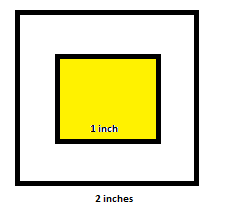
If the yellow region is a 1 inch square and the outside square is of 2 inches. If the center falls in the yellow region, the coin will not touch the grid line. Since the total area is 4 and the area of the yellow region is 1, the probability is ¼ .
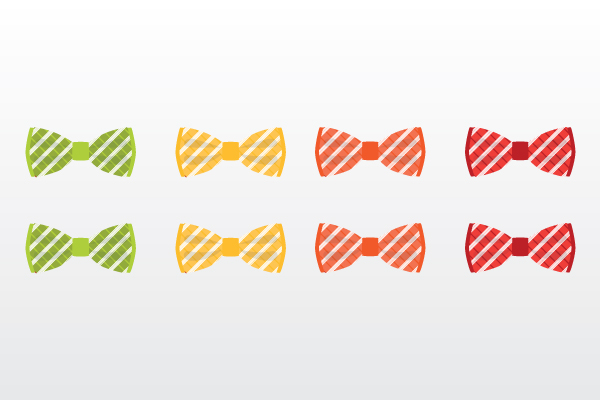
24) There are a total of 8 bows of 2 each of green, yellow, orange & red. In how many ways can you select 1 bow?
Solution: (C)
You can select one bow out of four different bows, so you can select one bow in four different ways.
25) Consider the following probability density function: What is the probability for X≤6 i.e. P(x≤6)
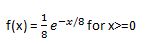 What is the probability for X≤6 i.e. P(x≤6)
Solution: (B)
To calculate the area of a particular region of a probability density function, we need to integrate the function under the bounds of the values for which we need to calculate the probability.
Therefore on integrating the given function from 0 to 6, we get 0.5276
26) In a class of 30 students, approximately what is the probability that two of the students have their birthday on the same day (defined by same day and month) (assuming it’s not a leap year)?
For example – Students with birthday 3rd Jan 1993 and 3rd Jan 1994 would be a favorable event.
Solution: (C)
The total number of combinations possible for no two persons to have the same birthday in a class of 30 is 30 * (30-1)/2 = 435.
Now, there are 365 days in a year (assuming it’s not a leap year). Thus, the probability of people having a different birthday would be 364/365. Now there are 870 combinations possible. Thus, the probability that no two people have the same birthday is (364/365)^435 = 0.303.
Thus, the probability that two people would have their birthdays on the same date would be 1 – 0.303 = 0.696
27) Ahmed is playing a lottery game where he must pick 2 numbers from 0 to 9 followed by an English alphabet (from 26-letters). He may choose the same number both times.
If his ticket matches the 2 numbers and 1 letter drawn in order, he wins the grand prize and receives 100. Under any other circumstance, he wins nothing. The game costs him $5 to play. Suppose he has chosen 04R to play.
What is the expected net profit from playing this ticket?
B) -1.82
C) $-1.82
D) $1.82
Solution: (B)
Expected value in this case
E(X) = P(grand prize)(10405-5)+P(small)(100-5)+P(losing)(-5)
P(grand prize)= (1/10)(1/10)(1/26)
P(small) = 1/26-1/2600, the reason we need to do this is we need to exclude the case where he gets the letter right and also the numbers rights. Hence, we need to remove the scenario of getting the letter right.
P(losing ) = 1-1/26-1/2600
Therefore we can fit in the values to get the expected value as $2.81
28) Assume you sell sandwiches. 70% people choose egg**, and the rest choose chicken. What is the probability of selling 2 egg sandwiches to the next 3 customers?**
Solution: (C)
The probability of selling Egg sandwich is 0.7 & that of a chicken sandwich is 0.3. Now, the probability that next 3 customers would order 2 egg sandwich is 3 * 0.7 * 0.7 *0.3 = 0.44. They can order them in any sequence, the probabilities would still be the same.
Question context: 29 – 30
HIV is still a very scary disease to even get tested for. The US military tests its recruits for HIV when they are recruited. They are tested on three rounds of Elisa( an HIV test) before they are termed to be positive.
The prior probability of anyone having HIV is 0.00148. The true positive rate for Elisa is 93% and the true negative rate is 99%.
29) What is the probability that a recruit has HIV, given he tested positive on first Elisa test? The prior probability of anyone having HIV is 0.00148. The true positive rate for Elisa is 93% and the true negative rate is 99%.
Solution: (A)
I recommend going through the Bayes updating section of this article for the understanding of the above question.
30) What is the probability of having HIV, given he tested positive on Elisa the second time as well.
The prior probability of anyone having HIV is 0.00148. The true positive rate for Elisa is 93% and the true negative rate is 99%.
Solution: (C)
I recommend going through the Bayes updating section of this article for the understanding of the above question.
31) Suppose you’re playing a game in which we toss a fair coin multiple times. You have already lost thrice where you guessed heads but a tails appeared. Which of the below statements would be correct in this case?
A) You should guess heads again since the tails has already occurred thrice and its more likely for heads to occur now
B) You should say tails because guessing heads is not making you win
C) You have the same probability of winning in guessing either, hence whatever you guess there is just a 50-50 chance of winning or losing
D) None of these
Solution: (C)
This is a classic problem of gambler’s fallacy/monte carlo fallacy, where the person falsely starts to think that the results should even out in a few turns. The gambler starts to believe that if we have received 3 heads, you should receive a 3 tails. This is however not true. The results would even out only in infinite number of trials.
32) The inference using the frequentist approach will always yield the same result as the Bayesian approach.
A) TRUE
B) FALSE
Solution: (B)
The frequentist Approach is highly dependent on how we define the hypothesis while Bayesian approach helps us update our prior beliefs. Therefore the frequentist approach might result in an opposite inference if we declare the hypothesis differently. Hence the two approaches might not yield the same results.
33) Hospital records show that 75% of patients suffering from a disease die due to that disease. What is the probability that 4 out of the 6 randomly selected patients recover?
Solution: (C)
Think of this as a binomial since there are only 2 outcomes, either the patient dies or he survives.
Here n =6, and x=4. p=0.25(probability if living(success)) q = 0.75(probability of dying(failure))
P(X) = nCx pxqn-x = 6C4 (0.25)4(0.75)2 = 0.03295
34) The students of a particular class were given two tests for evaluation. Twenty-five percent of the class cleared both the tests and forty-five percent of the students were able to clear the first test.
Calculate the percentage of students who passed the second test given that they were also able to pass the first test.
D) 45%
Solution: (C)
This is a simple problem of conditional probability. Let A be the event of passing in first test.
B is the event of passing in the second test.
P(AꓵB) is passing in both the events
P(passing in second given he passed in the first one) = P(AꓵB)/P(A)
= 0.25/0.45 which is around 55%
35) While it is said that the probabilities of having a boy or a girl are the same, let’s assume that the actual probability of having a boy is slightly higher at 0.51. Suppose a couple plans to have 3 children. What is the probability that exactly 2 of them will be boys?
Solution: (A)
Think of this as a binomial distribution where getting a success is a boy and failure is a girl. Therefore we need to calculate the probability of getting 2 out of three successes.
P(X) = nCx pxqn-x = 3C2 (0.51)2(0.49)1 = 0.382
36) Heights of 10 year-olds, regardless of gender, closely follow a normal distribution with mean 55 inches and standard deviation 6 inches. Which of the following is true?
A) We would expect more number of 10 year-olds to be shorter than 55 inches than the number of them who are taller than 55 inches
B) Roughly 95% of 10 year-olds are between 37 and 73 inches tall
C) A 10-year-old who is 65 inches tall would be considered more unusual than a 10-year-old who is 45 inches tall
D) None of these
Solution: (D)
None of the above statements are true.
37) About 30% of human twins are identical, and the rest are fraternal. Identical twins are necessarily the same sex, half are males and the other half are females. One-quarter of fraternal twins are both males, one-quarter both female, and one-half are mixed: one male, one female. You have just become a parent of twins and are told they are both girls. Given this information, what is the probability that they are identical?
A) 50%
B) 72%
C) 46%
D) 33%
Solution: (C)
This is a classic problem of Bayes theorem.
P(I) denoted Probability of being identical and P(~I) denotes Probability of not being identical
P(Identical) = 0.3
P(not Identical)= 0.7
P(FF|I)= 0.5
P(MM|I)= 0.5
P(MM|~I)= 0.25
P(FF|~I)= 0.25
P(FM|~I)= 0.25
P(I|FF) = 0.46
38) Rob has fever and the doctor suspects it to be typhoid. To be sure, the doctor wants to conduct the test. The test results positive when the patient actually has typhoid 80% of the time. The test gives positive when the patient does not have typhoid 10% of the time. If 1% of the population has typhoid, what is the probability that Rob has typhoid provided he tested positive?
Solution: (B)
We need to find the probability of having typhoid given he tested positive.
=P(testing +ve and having typhoid) / P(testing positive)
= = 0.074
39) Jack is having two coins in his hand. Out of the two coins, one is a real coin and the second one is a faulty one with Tails on both sides. He blindfolds himself to choose a random coin and tosses it in the air. The coin falls down with Tails facing upwards. What is the probability that this tail is shown by the faulty coin?
D) 1/4
Solution: (B)
We need to find the probability of the coin being faulty given that it showed tails.
P(Faulty) = 0.5
P(getting tails) = 3/4
P(faulty and tails) =0.5*1 = 0.5
Therefore the probability of coin being faulty given that it showed tails would be 2/3
40) A fly has a life between 4-6 days. What is the probability that the fly will die at exactly 5 days?
A) 1/2
B) 1/4
C) 1/3
D) 0
Solution: (D)
Here since the probabilities are continuous, the probabilities form a mass function. The probability of a certain event is calculated by finding the area under the curve for the given conditions. Here since we’re trying to calculate the probability of the fly dying at exactly 5 days – the area under the curve would be 0. Also to come to think of it, the probability if dying at exactly 5 days is impossible for us to even figure out since we cannot measure with infinite precision if it was exactly 5 days.
If the code below is run, what is the probability that it prints Heads exactly twice?
import random
for i in range(3):
    if random.choice([True, False]):
        print('Heads')
If the code below is run, what is the probability that 'Sunny' is printed?
import random
if random.uniform(0, 1) < 0.3:
    print('Rainy')
else:
    print('Sunny')
What is the probability that the sum of the numbers generated in the above code will be greater than 25?
import random
numbers = [random.randint(1, 10) for _ in range(5)]
if sum(numbers) > 25:
    print('Sum is greater than 25')
There’s no real closed-form way to do this. You would have to brute-force enumerate the combinations of 5 numbers, who’s sum is greater than 25. Luckily, any of these combinations is equally likely, so the probability is just inverse.
This is known as the stars and bars which we cover in the (4.1) Combinatorics section.
##### ↳ **Bonus:** How could you solve this using [[(3.2) Dynamic Programming]]
What is the probability that 'D selected' is printed when this code is run?
import random
if random.randint(1, 5) == 3:
	if random.choice(['A', 'B', 'C', 'D']) == 'D':
	    print('D selected')
Can you give an example of two events which are not disjoint, but independent?
Can you give an example of two events which are disjoint, but dependent?
Twp disjoint events CANNOT BE INDEPENDENT unless one of them is impossible (Pr=0). Proof via Independent = Pr(A n B) = Pr(A) * Pr(B)