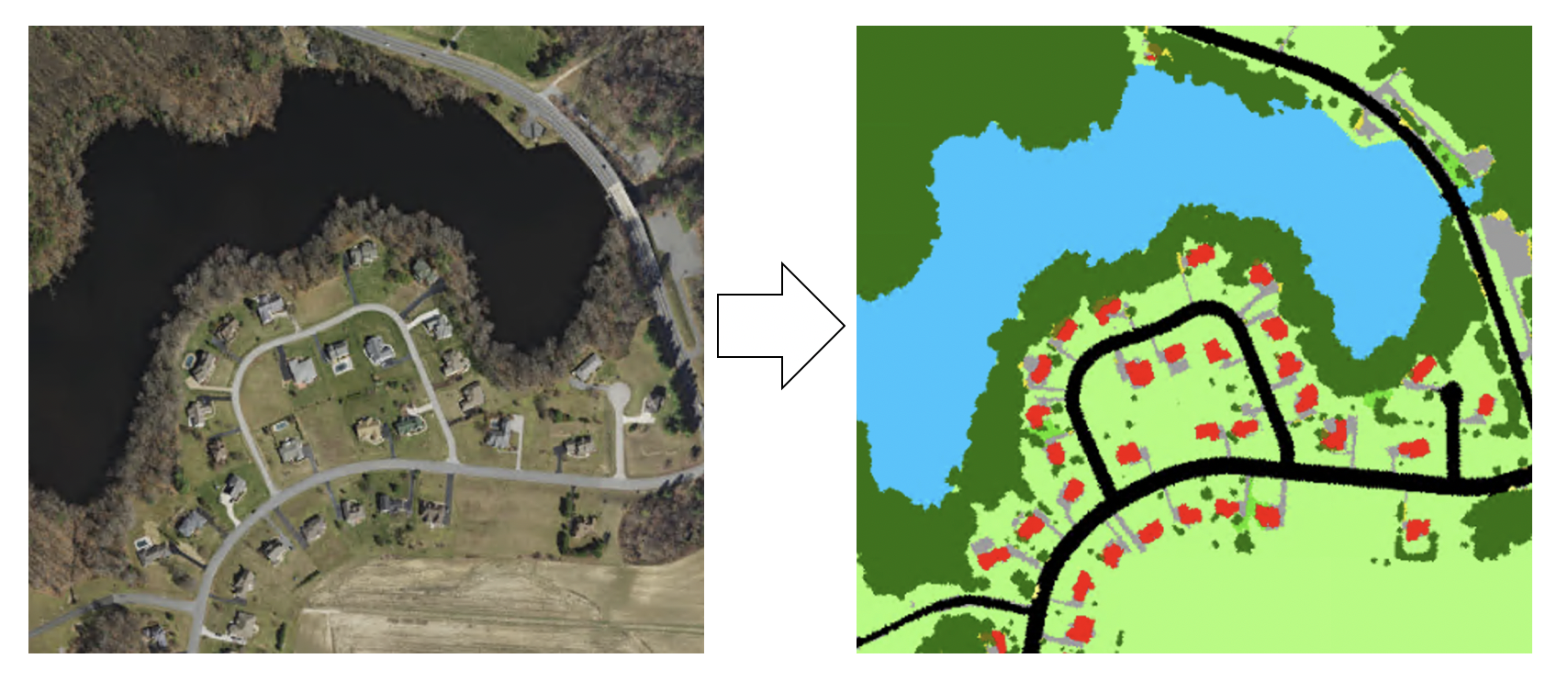
U-Net is a convolutional neural network that was developed for biomedical image segmentation at the Computer Science Department of the University of Freiburg.
https://youtu.be/NhdzGfB1q74?si=OB2BYVCuxfXg0x05
About:
- low number of parameters (efficent)
- deals with small trainin datasets (common in medical imaging)
Architecture
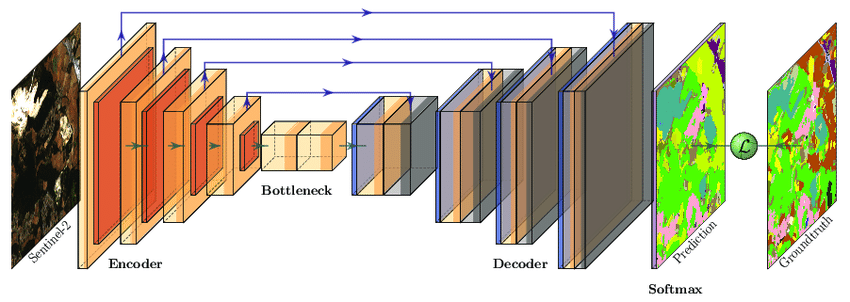
- encoder (contraction path)
- typical convolution architecture
- convolutions
- follows by ReLU and max pooling
- downsampling decreases spatial dimensions while depth increases (no. feature maps)
- this helps the network encode the input image into feature represnetations at multiple levels of abstraction
- decode (expansive path)
- purpose is to enable precise localization using transposed/de-convolutions
- reconstructs the segmentation map from encoded feature representation
- also includes convolutions and ReLU activations after each upsampling step
- skip connections
- provide direct pathway between layers at the same level of encoder - decoder
- by concatenating feature maps, the network can use fine-grained details lost during downsampling to refine its output (information about pixels vs. semantic feature represenations), improving segmentation accuracy
- few parameters
- designed to work well with few training samples
- small number of parameters
- As the input image passes through the contraction path, the network extracts increasingly complex features while reducing the spatial dimensions.
- At the bottom of the U, the network has a compressed representation encapsulating the high-level context of the image.
- As the image data is passed up the expansive path, the network uses the skip connections to reintegrate detailed local information from the contraction path, refining the segmentation map at each step.
- Output: the number of channels in the output layer dictates the number of classes the network is expected to distribguish. the last layer of the U-Net architecture typically uses a softmax (for mutually exclusive classes) or sigmoid (for independent classes) activation function to classify each pixel.
Why was the U-net initially developed?
- medical imaging
What else can it do?
- image generation?